Breakthrough in wave physics drives renewable innovation
When ocean waves break, they release energy and can damage coasts 鈥� but are hard to predict. Using AI, 黑料网吃瓜爆料 researchers discovered a new equation that explains this process, improving offshore engineering and climate forecasting.
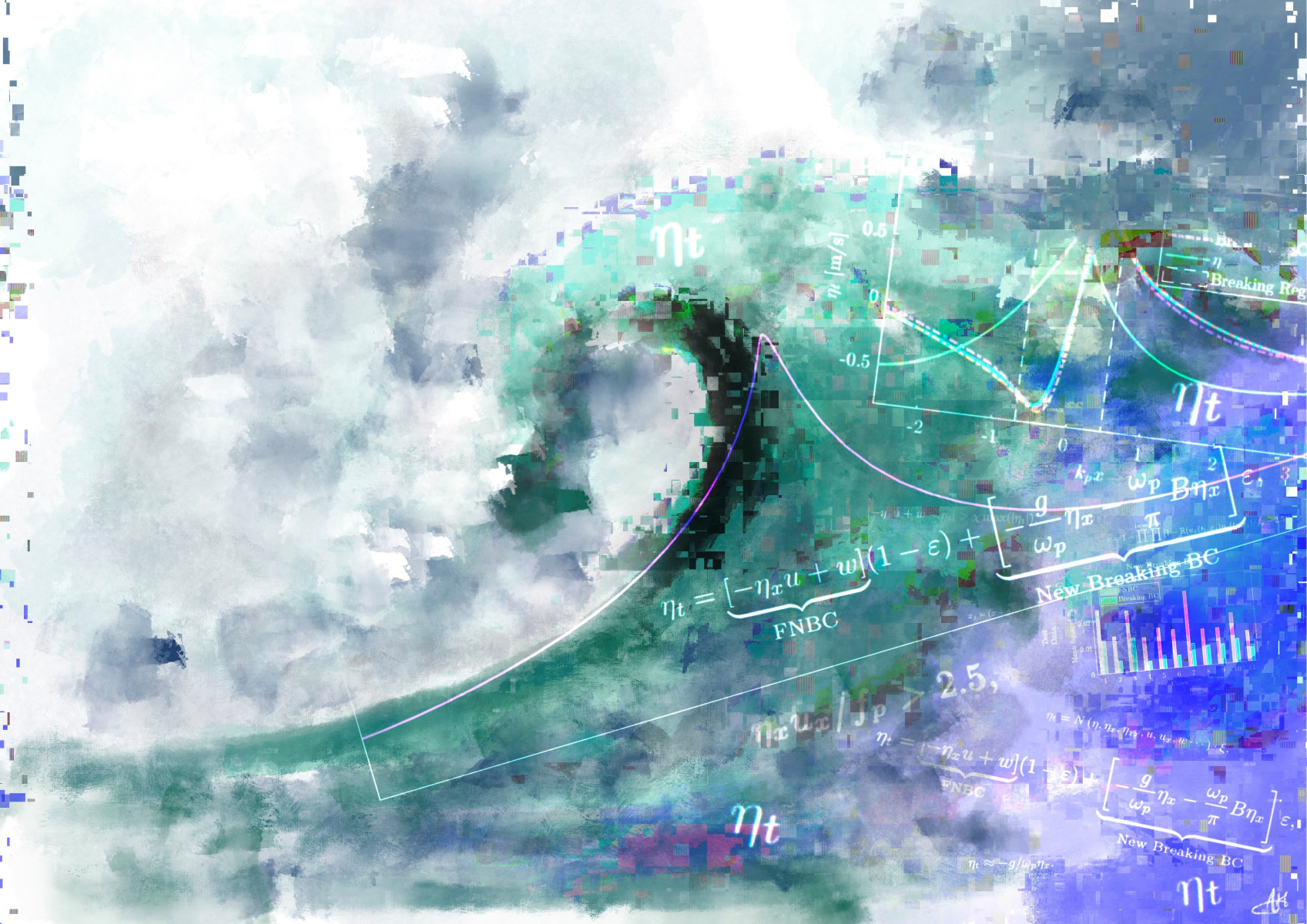
Breaking waves shape our coastlines, sink cruise ships and fishing vessels and play a crucial role in climate systems. Yet, despite decades of research, scientists have struggled to fully explain why and how waves break.
Now, researchers led by Dr Tim Tang at 黑料网吃瓜爆料 are using artificial intelligence to unlock fresh insights. By training AI on computer simulations that mimic the ocean in fine detail, the team have uncovered a new mathematical equation that describes when and how waves break.
Unlike traditional 鈥榖lack box鈥� AI, which makes predictions without showing its reasoning, this method provides interpretable results by human beings. It has revealed that, in deep water, the wave breaking can start from a speed difference between the surface and bulk of water underneath, which creates a small 鈥渨aterslide鈥�. Similar to landslide, the water at surface running down is likely to trigger a full energic breaking.
The new equation could help scientists model the ocean more accurately and simulate breaking waves more efficiently, with applications ranging from advancing offshore renewable engineering to climate forecasting. As Dr Tang explains: 鈥淲ave breaking is one of the last unsolved puzzles in ocean science. By combining AI with physics, we鈥檙e not just improving our models 鈥� we鈥檙e uncovering new insights about the ocean wave itself.鈥�
Meet the researchers
Dr Tim Tang is a Lecturer in Fluids Simulation and Digital Twins in 黑料网吃瓜爆料鈥檚 Department of Mechanical and Aerospace Engineering. He applies scientific machine learning to fluid mechanics challenges, with a focus on rogue waves and offshore renewable energy. Using state-of-the-art machine learning techniques, his research improves resilience against oceanic hazards and was recently featured in BBC News and Science Focus.