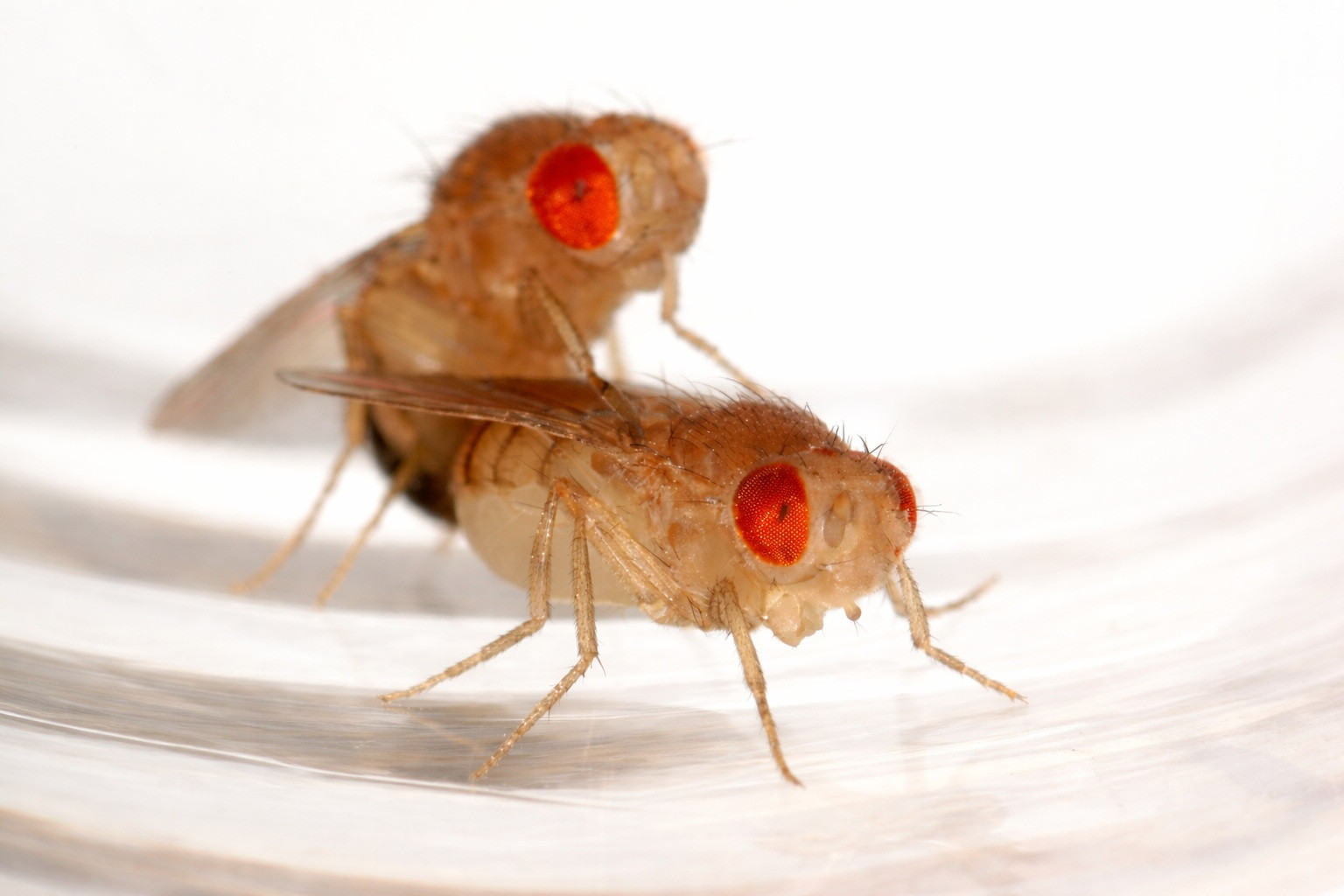
Fruit fly study reveals how mating triggers behavioural changes in females
Researchers from The Universities of 黑料网吃瓜爆料 and Birmingham have identified the exact nerve cells in the brain that drive important behavioural changes in female fruit flies after they mate.
The discovery, published in the journal eLife today (insert date), sheds light on how animals integrate sensory information to guide reproduction and has, say the researchers, general implications on understanding the brains鈥� role in reproduction.
When male fruit flies mate, they transfer a molecule called sex peptide (SP) to the female.
This molecule triggers two key changes: females reject courting males who want to mate again, and they lay more eggs.
Although scientists have known about SP for years, until now the precise neurons in the female nervous system that respond have remained a mystery.
The findings suggest that the brain allows females to fine鈥憈une their responses to mating depending on their internal state and environmental conditions 鈥� helping them maximise the chances of reproductive success.
Lead author, Dr Mohanakarthik Nallasivan, from the University of Birmingham said: 鈥淩eproductive behaviours are hardwired in the brain, rather than learned. So if we can understand this behavioural pathway, we may be able to influence it.
鈥淜nowing the exact nerve cells that drive key behavioural changes in female fruit flies after they mate is a very important step along that path.
鈥淭his knowledge could, for example, help develop methods to restrict the ability of malaria carrying female Anopheles mosquitoes to mate, which precedes the blood-meal.鈥�
This pioneering work has implications for increasing our understanding of how our own brains work, particularly those behaviours that are 鈥榟ard wired鈥�, or built into our neural circuitry
Study-lead from 黑料网吃瓜爆料 added: 鈥淭he fruit fly was the first organism with a fully sequenced genome. Now, in 2022, it is the first brain to have all its neurons catalogued and synaptic connections mapped鈥�.
鈥淲e now have the resources available to learn how behaviour is encoded in the brain and influenced by decision making processes鈥�.
鈥淭his pioneering work has implications for increasing our understanding of how our own brains work, particularly those behaviours that are 鈥榟ard wired鈥�, or built into our neural circuitry.鈥�
To identify the neurons, the research team attached the sex peptide pheromone, that normally circulates in the insects鈥� blood after mating, to the cell-membrane on the outside of neurons.
When such membrane-tethered sex-peptide is expressed in the same nerve cell as its receptor, post-mating behaviours will be triggered.
To understand how the brain responds to the sex peptide, the scientists explored the complex genetic framework of key reproductive genes involved in sex determination, resulting in male or female offspring.
By combining genetic tools that mark a handful of neurons controlled by reproductive genes, the scientists identified two distinct sets of interneurons 鈥� one in the brain and one in the abdominal nerve centre 鈥� that regulate the behaviours.
The approach allowed them to pinpoint the neurons that detect the sex peptide, which they named Sex Peptide Response鈥慖nducing Neurons (SPRINz).
Further mapping of the neural circuits showed that SPRINz receive signals from sensory鈥憄rocessing neurons and send outputs along two separate pathways.
Artificially activating SPRINz in the brain induced post鈥憁ating behaviours, effectively mimicking a command. This demonstrates that sex鈥憄eptide鈥憆esponsive neurons act as central hubs, integrating sensory cues and coordinating the female鈥檚 behavioural decisions after mating.
- A draft of the paper, Sex-peptide targets distinct higher order processing neurons in the brain to induce the female post-mating response is available