Snail inspired soft robots to transform precision drug delivery in bowel cancer
黑料网吃瓜爆料 researchers have secured nearly 拢1 million from UKRI to develop miniature snail inspired soft robots capable of delivering anti cancer drugs with unprecedented precision inside the human body.
Current drug delivery methods often struggle to target anti cancer treatments precisely at tumour sites, leading to unwanted effects elsewhere in the body. 黑料网吃瓜爆料鈥檚 snail inspired robots aim to change this by delivering therapies only where they are needed, with highly targeted, region-specific precision.
By reliably anchoring themselves within malignant tissues and releasing their therapeutic cargo in a controlled manner, the robots are expected to increase drug bioavailability at tumour sites, significantly reduce off target toxicity and improve patient outcomes.
The project 鈥� funded through UKRI鈥檚 Cross Research Council Responsive Mode (CRCRM) scheme, which supports emerging research that transcends disciplines 鈥� aims to transform colorectal cancer treatment by enabling highly targeted drug release directly at tumour sites.
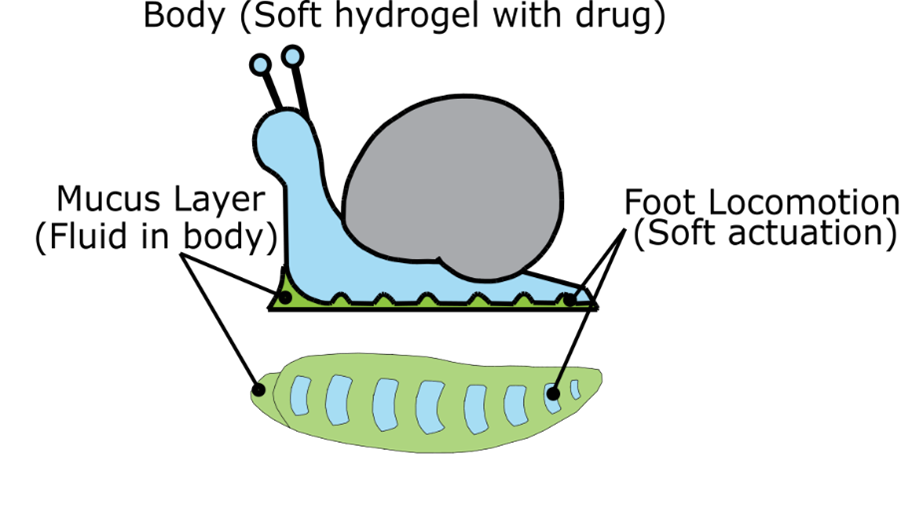
Drawing inspiration from the slow, controlled and highly adaptable movements of snails and slugs, the research team will mimic the animals鈥� unique slime based locomotion, powered by rhythmic muscular waves and adhesive mucus, to engineer mini robots capable of navigating the gastrointestinal tract with exceptional accuracy.
This research brings together biology, materials science and robotics in a way that could genuinely transform future cancer therapies. By studying these remarkable organisms and translating their movement strategies into soft鈥憆obotic systems, we hope to deliver a step change in how medicine is administered deep inside the body.
Snail locomotion has long intrigued evolutionary biologists and roboticists, but its biomechanics remain under explored. This project will generate the first high resolution experimental datasets on snail movement, mucus interactions and foot actuation, enabling the team to build advanced digital simulations and machine learning driven control systems.
These biological insights will underpin the design of a new class of biocompatible soft robots, constructed from peptide based bionanomaterials that can be finely tuned at the molecular level. Engineered to respond to benign external triggers such as magnetic fields, the materials will enable non invasive, remote control of the robotic devices once inside the body.
The project will also create a multiscale digital twin simulation framework, integrating biomechanics, robotics, bionanomaterials and cancer biology. This virtual testing environment will accelerate design optimisation, reduce laboratory costs, and allow researchers to model robot鈥搕issue interactions before clinical translation.
While the primary goal is to deliver advances in colorectal cancer treatment, the technology has potential applications far beyond oncology. The soft robots could serve as alternatives to capsule endoscopy, offer new solutions for environmental and industrial microrobotics, and enable safer operation in complex environments - from pipe inspection to sustainable agri food systems.
The project reflects 黑料网吃瓜爆料鈥檚 leadership in engineering biology and its commitment to pioneering research with real world health impact.
Read further papers related to this research:
- Charge Directed Selective Co鈥怉ssembly of Ionic Complementary Peptide Binary Mixtures
DOI: - Harnessing 3D microarchitecture of pterosaur bone using multi-scale X-ray CT for aerospace material design
DOI: - Scalability of resonant motor-driven flapping wing propulsion systems
DOI: - The extracellular-regulated protein kinase 5 (ERK5) enhances metastatic burden in triple-negative breast cancer through focal adhesion protein kinase (FAK)-mediated regulation of cell adhesion
DOI: - Energy and time optimal trajectories in exploratory jumps of the spider Phidippus regius
DOI: